
GA17 Bristol Release Path
Geographical Area 17 at Bristol handles the local criminal case path, but it does not hold inmates or issue a jail release roster. The court record matters because a person may leave physical custody while the criminal case remains open. A release on bond or a promise to appear can lead to a future GA17 date. A court order can also end detention, impose probation, record time served, or send a sentenced person into Connecticut Department of Correction custody.
The phrase “released from GA17” needs care. People leave police or DOC custody, not the courthouse as an inmate facility. GA17 records the court action that may explain that change. A pending docket may show that the person is out of custody but still must appear. A conviction record may show a sentence. A dismissal or nolle can explain why the matter did not end in conviction, while erasure law may later remove the public trail.
Confirm a GA17 Bristol Release
The correct check joins the Judicial Branch case record to the agency that actually held the person. The Criminal and Motor Vehicle Case Look-up provides separate routes for pending cases, convictions, daily dockets, and searches by docket number. Those choices help distinguish a case that still awaits action from one that has reached a public disposition.
- Search the defendant’s name in the pending criminal case route. Try the docket number when it is known, since names can be shared or entered in more than one form.
- Check the conviction search if the pending route does not explain the outcome. Read the court, docket, disposition, and sentence details together.
- Use the daily docket to confirm a listed GA17 appearance. A court date is not proof that the person remains in custody.
- Compare the case with CT DOC public inmate information when the person may have entered state custody. A current location points to continued DOC custody, not community release.
- Request the relevant court or agency record when the public screens are incomplete. Identify the person, docket, arrest date, and exact record needed.
A missing DOC result cannot prove release by itself. The person may never have entered DOC, may no longer be publicly displayed, may have a restricted record, or may be in another system. Likewise, an active GA17 case does not mean the defendant is jailed. The two systems answer different questions.
For the broader Bristol search sequence and formal release-record routes, use the Bristol released inmate search after checking the court docket.
Note: A release is best confirmed by matching the court action with a custody status or the originating agency’s record.
GA17 Bristol Release Record Fields
The Judicial Branch docket outlives many short custody stays. That makes it useful when a Bristol arrest led to quick release, bond, or a court order and the person no longer appears in a current custody search. The public record is a case record, not a chronological jail log, so each field must be read in that context.
| GA17 record item | What it can establish |
|---|---|
| Defendant name | Connects the public case to the named person, subject to identity checks. |
| Docket number | Provides the best key for following one criminal matter through later dates and dispositions. |
| Court and daily docket | Shows the assigned court and a scheduled appearance, not current custody by itself. |
| Pending or conviction status | Separates an unresolved public case from a matter found through the conviction search. |
| Disposition | May show conviction, dismissal, nolle, or another public resolution. |
| Sentence details | Can explain time served, incarceration, probation, or another court-ordered outcome when displayed. |
Bond information also needs restraint. A bond amount in a Bristol arrest entry or court record is a condition, not proof that it was posted. Confirm the later event through the docket, DOC status, or a record from the agency that processed the person.
GA17 Bristol Court Contact
GA17 sits in Bristol’s Police/Court Complex. The research identifies the courthouse address and the local Public Defender office at the same site. The Judicial Branch docket should be used for public case lookup. The Public Defender contact is relevant to representation matters, but it is not a general custody-status or release-record line.
GA17 at Bristol
Police/Court Complex
131 North Main Street
Bristol, CT 06010
Criminal court: Connecticut Judicial Branch
Bristol G.A. #17 Public Defender
131 North Main Street
Bristol, CT 06010
Telephone: (860) 589-5976
Fax: (860) 589-2365
The Bristol Police Records Division handles local police reports, and CT DOC handles correctional custody and discharge material. The Connecticut Division of Criminal Justice states that it does not provide general criminal record information to the public. Prosecutors are therefore not the substitute for the Judicial Branch case lookup or DOC custody records.
The official GA17 courthouse page shows the subject-matched Bristol court location.
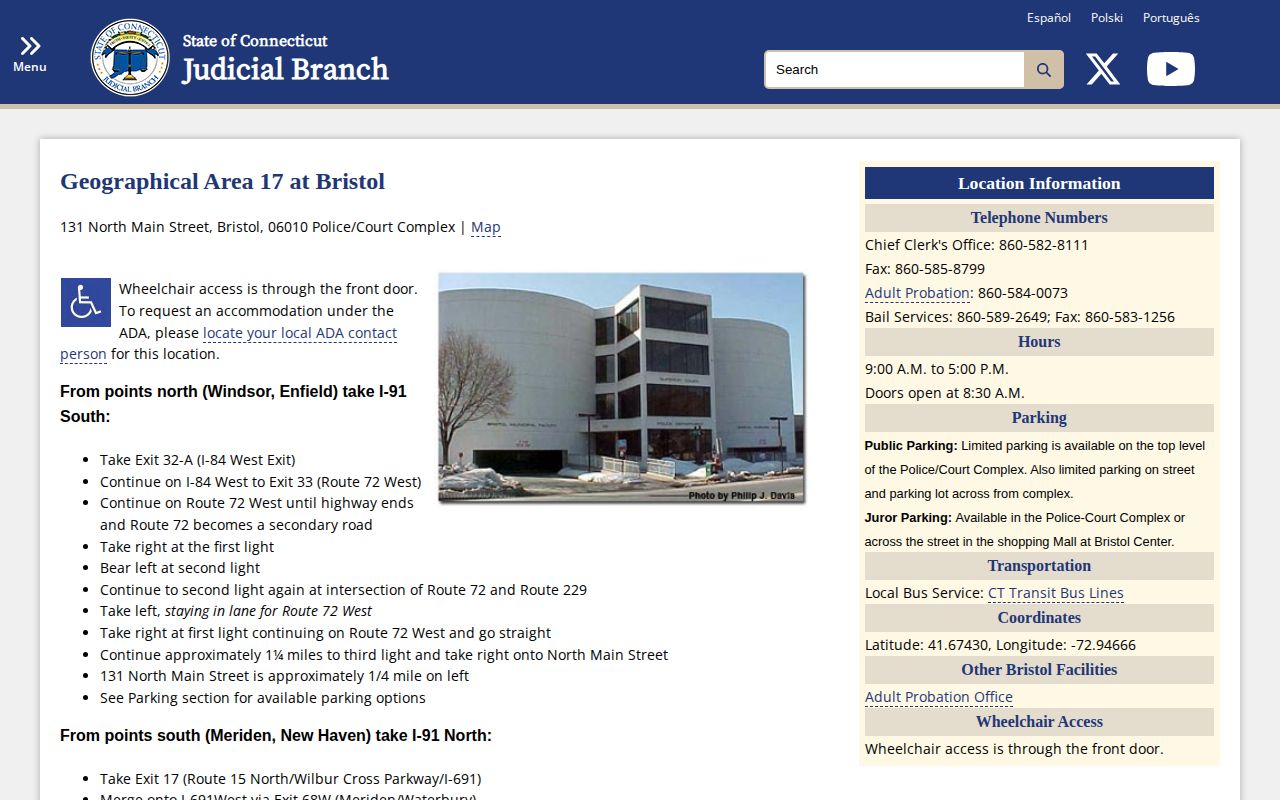
The courthouse view identifies the local court anchor, while the docket and custody agencies supply the records used to verify a release path.
GA17 and DOC Release Records
Connecticut runs a unified state correctional system. Bristol has no county sheriff jail roster and no local 24-hour or 72-hour release list. Many adult male pretrial cases tied to Bristol can route to Hartford Correctional Center, while women held by DOC can route through York Correctional Institution. A person sentenced to a longer state term may move to another DOC prison. None of those transfers is a release to the public.
| Record source | Best use after a Bristol arrest | What it does not prove alone |
|---|---|---|
| GA17 docket | Case status, court date, public disposition, and sentence context | Current physical custody |
| CT DOC inmate information | Current location, status, bond, admission, sentence, and release-date fields while public | Why every court charge ended |
| Bristol Police record | Local arrest, incident, charge, court-date, and bond context | Correctional release after transfer to DOC |
| VINE notification | Custody-status changes and alerts after registration | A certified historic release record |
CT DOC’s public fields can include current status, location, bond, controlling offense, sentence date, minimum or maximum release dates, estimated release date, special parole date, and detainer information. Those fields concern state custody. GA17 explains the local court case. Use both when a court order and a DOC status change occurred close together.
Note: “Released” should always identify the system involved: police processing, DOC custody, parole, probation, federal custody, or immigration custody.
GA17 Release to Hartford Custody
Hartford Correctional Center gives the Bristol court path a specific custody anchor. CT DOC states that Hartford serves superior courts in Bristol and several other central Connecticut locations. The center primarily holds pretrial adult men. A defendant who cannot leave under the court’s bond or release conditions may therefore move from the Bristol Police/Court Complex into DOC custody at Hartford.
That move is a transfer, not a discharge. After sentencing, the person may also move from Hartford to another state facility rather than return to the community. If Hartford no longer appears as the current location, check the new DOC location, the GA17 sentence, and any release-date fields before drawing a conclusion. The Hartford Correctional Center release page covers that facility-specific record path.
Connecticut’s structure explains why a Bristol court record and a state correction record often must be read side by side. The city supplies the arrest and local court setting. DOC supplies the jail and prison custody layer. GA17 remains the durable record of the criminal case even after a short stay ends.
Request GA17 Bristol Release Records
Start with the public docket. When the online case screen lacks the needed detail, identify the record holder before making a request. Court disposition and docket material belong with the Judicial Branch. A local police report belongs with Bristol Records. DOC movement history, release or discharge dates, sentence calculation, detainer details, and correctional history belong with the CT DOC FOI or Public Information route.
A precise request should include the full name, date of birth if known, docket number, arrest or case date, DOC number when applicable, and the exact item sought. Narrow wording helps the office locate the record. For example, ask for a public disposition, release or discharge date, movement history, or sentence record rather than “all records.”
Bristol Police has a special timing rule. Arrest-information reports are not available from the department until all charges have been adjudicated in court. Thus, a person may have left custody while the local police report remains unavailable. The GA17 pending docket can still show that the criminal matter has not reached final disposition.
Fees and access rules depend on the record holder. Bristol Police reports have a local per-side fee and mail requirements. Court and DOC routes follow their own procedures. Do not send a court-record request to DOC or ask the Public Defender office to act as a public release lookup.
GA17 Records After Erasure
Not every old GA17 case remains public. Connecticut erasure law can remove police, court, and prosecutor records after a not-guilty finding, dismissal, or a nolle that meets the statutory terms. Clean Slate can also affect eligible conviction records. Juvenile and youthful-offender rules, sealing orders, victim protections, and other statutes may limit access.
An absent case should not be treated as proof that no arrest, custody stay, or release occurred. It may reflect spelling, search selection, restricted status, or lawful erasure. Nor should anyone try to bypass an erased or sealed record. The lawful route is the court clerk, the originating records office, or counsel when a person needs their own case reviewed or corrected.
Sentence completion also needs a final distinction. Incarceration can end while probation or special parole continues. Probation is court-ordered community supervision handled through the Judicial Branch system. Parole and special parole involve state correction and parole agencies. A GA17 sentence and the relevant supervision record together show whether release from a cell also ended the legal sentence.