
Bristol Parole and Probation
A released Bristol person may be under parole, special parole, probation, transitional supervision, or no supervision at all. These labels are not interchangeable. The Connecticut Board of Pardons and Paroles makes parole decisions. CT DOC Parole and Community Services supervises many people in the community after a prison release. By contrast, the Judicial Branch Court Support Services Division, known as CSSD, oversees adult probation and pretrial services for cases referred by Connecticut courts.
Parole is conditional release from a prison term before the maximum sentence ends. Probation is a sentence imposed by a judge, often with no prison term or with community supervision after confinement. Special parole is a court-ordered period that follows the prison portion of a sentence and is supervised in the parole system. Pretrial supervision applies before the criminal case is decided. A person can be out of a cell yet remain subject to court or agency rules.
| Supervision type | Who sets it | Best verification path |
|---|---|---|
| Parole | Board of Pardons and Paroles | BOPP docket or minutes, BOPP records, and CT DOC supervision contact |
| Special parole | Sentencing court, with parole administration | Court disposition, CT DOC special parole date, and Parole and Community Services |
| Probation | Connecticut court | Judicial Branch case lookup, sentencing record, and CSSD Adult Probation |
| Pretrial supervision | Court or bail process | Pending case docket and CSSD pretrial services |
- Eligibility
- The point when the law permits BOPP to consider parole.
- Suitability
- The Board's judgment about whether an eligible person should receive parole.
- Absconder
- A person alleged to have stopped reporting or left supervision without permission.
- Discharge
- The formal end of custody or a term of supervision.
Verify Bristol Post-Release Supervision
Start with the sentence and release path, not a general name search. Bristol Police records may identify the arrest and court date, but they do not prove that probation or parole is active. The Judicial Branch docket is strongest for a Bristol probation sentence. A state prison release calls for CT DOC, BOPP, and parole records. The Bristol released-inmate search and record path helps establish whether the person was in local police processing, DOC custody, federal custody, or another system before supervision began.
- Search the Connecticut Judicial Branch criminal case system by defendant or docket. Read the public disposition and sentence for probation or special parole terms.
- Check CT DOC inmate information when state custody was involved. Look for status, current location, estimated or maximum release dates, and the special parole date when shown.
- Review BOPP's current hearing links and the Connecticut Public Meeting Calendar for a parole hearing docket or posted minutes.
- Contact CSSD for a probation path or CT DOC Parole and Community Services for a parole path. Provide the full name, date of birth, docket number, and DOC number when known.
- Ask the record-owning agency for formal documentation when the public pages do not settle the question. Public display limits and erasure rules may restrict what appears online.
Connecticut VINE can send custody and some parole or release alerts, but it is not a public supervision-history archive. Court-case registration and inmate-custody registration may be separate. Use the docket or agency record when an exact legal status is needed.
Bristol Parole Hearing Records
BOPP publishes several kinds of hearing information, though research found no stand-alone statewide parole-results search. The Board's general hearing page says hearings may occur Monday through Friday and connect the Board office with the correctional institution by video. Current links appear on the BOPP home page. Individual events on the Connecticut Public Meeting Calendar may include a docket, agenda, minutes, purpose, time, and public access details.
The outcome needs careful reading. A grant or "voted to parole" decision can set an on-or-after date. BOPP says that is the first possible release day, not a promise of physical release that day. Sponsor review, placement, conditions, transport, discipline, a new charge, or another hold can delay the move. A matter can also be denied, continued for more information, or changed before release. Posted minutes, a BOPP FOI request to BOPPFOI@ct.gov, and direct case contact are the official paths when no searchable result is available.
The manifest-matched image below comes from the official hearing guidance. View the BOPP public hearing information source before relying on a date.
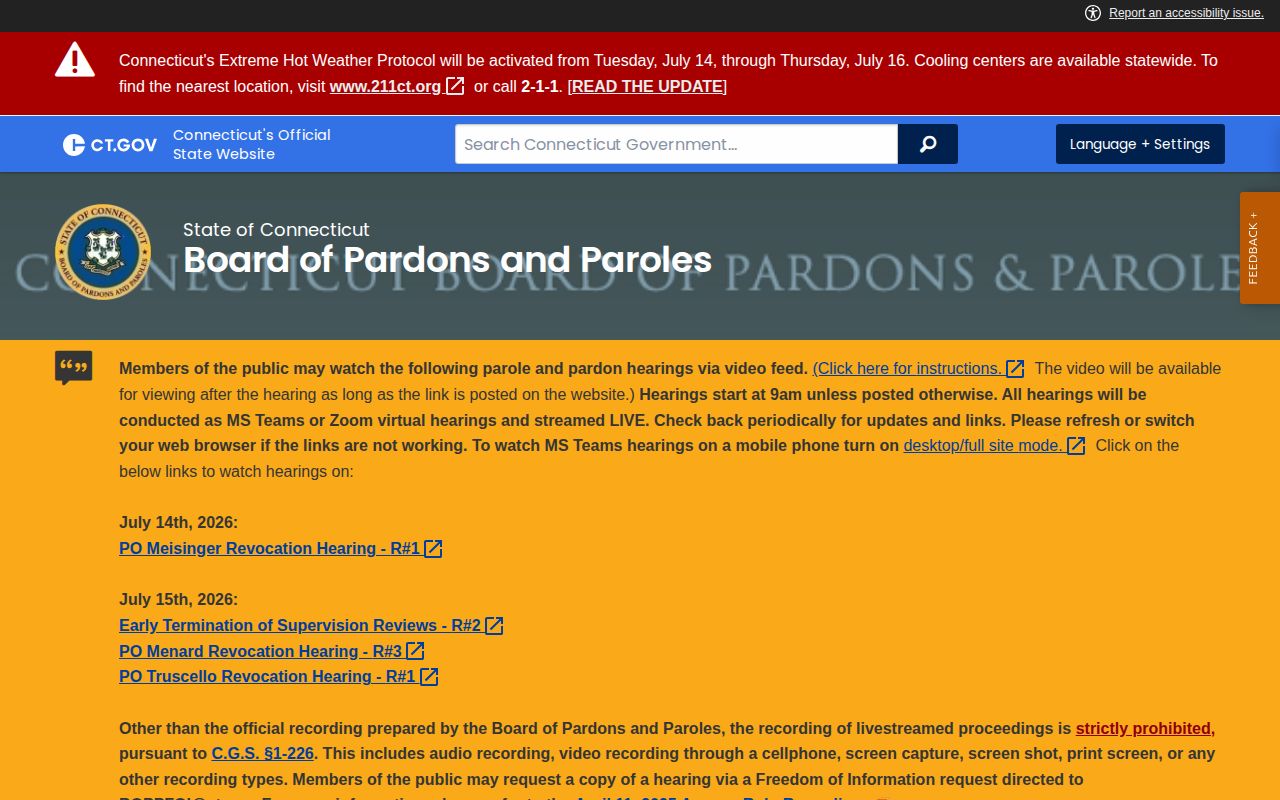
The hearing page helps locate the proceeding, while the docket, minutes, or agency record supplies the case-specific supervision result.
Note: Recording a livestream is prohibited except for the official Board recording, which may be requested through the BOPP FOI route.
Bristol Supervision Office Paths
Post-release supervision in Bristol splits at the agency level. CSSD handles probation and pretrial work for court-referred clients. CT DOC Operations identifies Parole and Community Services as the unit responsible for community supervision of people on parole. BOPP makes parole decisions but is not a substitute for the field unit that manages day-to-day conditions. This distinction is Section 19's Bristol supervision-office angle: a broad parole check will miss a court probation term, and a probation inquiry will not answer a parole release question.
Official supervision contacts
Judicial Branch Court Support Services Division
CSSD and Adult Probation information
Use for probation and pretrial supervision tied to a court case.
CT DOC Parole and Community Services
Operations Division
Use for supervision following parole, special parole, or a DOC community-release path.
Connecticut Board of Pardons and Paroles
Hearing and agency information
Official hearing copies may be requested at BOPPFOI@ct.gov.
A caller should have the legal name, date of birth, docket number, and CT DOC number if known. Agencies may limit details they disclose, but the identifiers help route the inquiry to the right record.
Bristol Reentry After Release
Connecticut's statewide reentry network is a distinct part of Bristol's release landscape. The CT DOC Offender Re-Entry Services Unit says each facility has a full-time reentry counselor. The unit works on referrals, identification, bus passes, key programs, and warm handoffs to reentry welcome centers. Bristol does not have a city-jail reentry program that replaces this state structure. A person leaving Hartford Correctional Center, York Correctional Institution, or another CT DOC site may be connected to the Hartford, New Britain, or Waterbury regional resource network.
Reentry help and supervision serve different roles. A counselor or 211 resource may help with documents, transport, health needs, and service referrals. Only the court, CSSD, BOPP, or CT DOC can confirm supervision terms. The 211 Connecticut reentry directory is useful for service connections, but it does not show whether a person is on probation or parole.
The official reentry source is shown in the matched image. The CT DOC reentry page remains the source for current unit details.
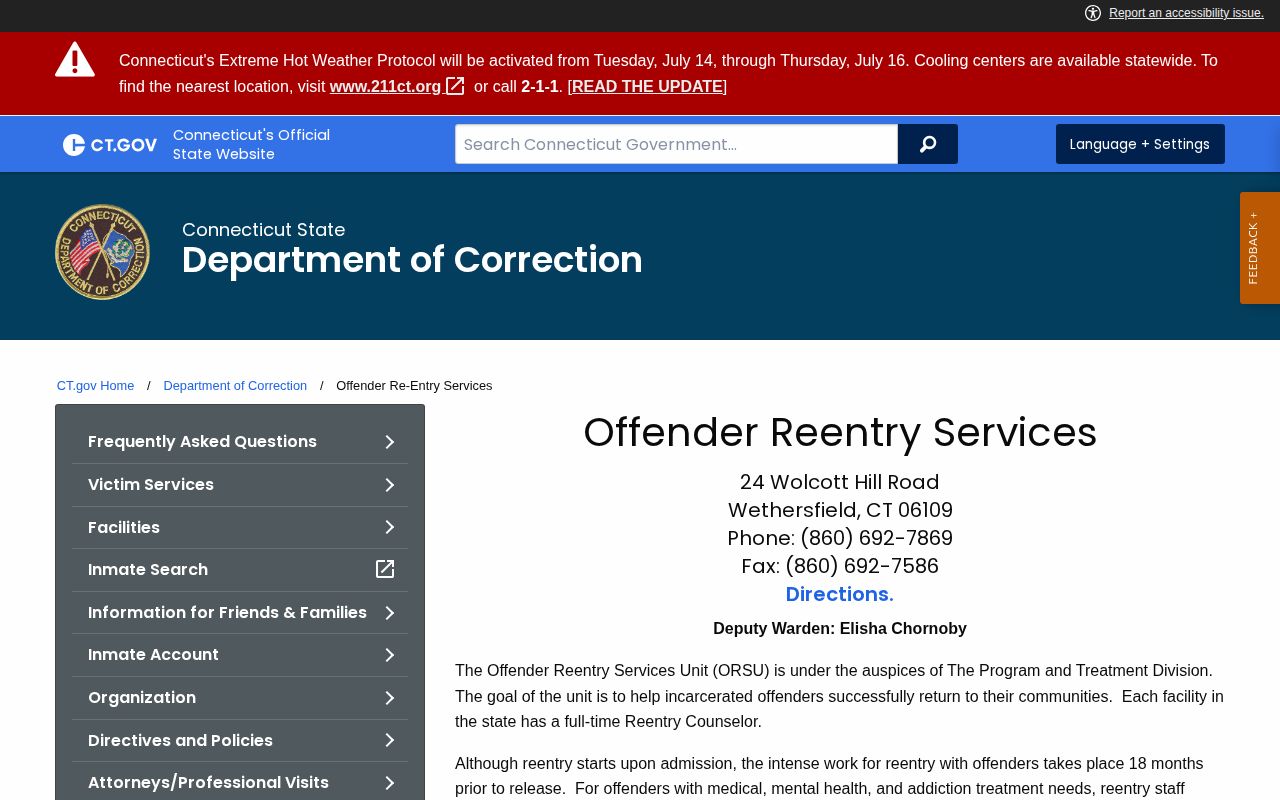
That statewide structure explains why a Bristol release may be supported outside city limits even when the criminal case stays in GA 17.
Bristol IDs After Release
Identification left behind at discharge follows a specific Connecticut rule. CT DOC Offender Re-Entry Services says IDs remain at the discharging facility for 30 days. If unclaimed, they go to DOC Central Office in Wethersfield and may be stored for up to two years after discharge. That can matter after a release from Hartford Correctional Center, York Correctional Institution, or another DOC facility serving a Bristol case.
For an ID question, CT DOC lists 860-692-6836, 860-692-7869, and DOC.ORSU@ct.gov. The Offender Re-Entry Services Unit is at 24 Wolcott Hill Road, Wethersfield, CT 06109. Ask first whether the document remains at the discharging facility. Give the person's name, DOC number, discharge facility, and approximate discharge date. This channel is for documents connected to DOC discharge. Bristol Police property from a local incident follows police procedures instead.
Note: The 30-day facility period and two-year Central Office storage rule apply to IDs held by CT DOC at discharge.
Bristol Supervision Violations
Conditions vary by sentence and case. Common categories can include reporting, travel approval, program attendance, court-ordered payments, or compliance with a release plan, but the actual order controls. A violation allegation is not the same as a new conviction. It may lead to an agency response, a warrant, a preliminary hearing, revocation proceedings, or a court appearance depending on whether the person is under parole or probation.
An absconder is someone alleged to have stopped reporting or left supervision without permission. No general public Bristol absconder database was documented in the research. Verify a possible warrant through the Judicial Branch case path and the supervising agency. BOPP calendars can include revocation, preliminary, or early-termination matters. VINE may supply a change alert, but it should not be treated as the final violation record.
Ending Bristol Release Supervision
Supervision ends through an official discharge, expiration, court action, or approved early termination. Leaving prison does not end a sentence when parole or special parole follows. In the same way, completing confinement does not erase a probation term imposed by the court. The public trail may include a court disposition, maximum or special parole date, BOPP minutes, or a discharge record held by the supervising agency.
For parole eligibility, CGS § 54-125a provides the legal framework. Many definite sentences over two years may reach eligibility after 50% of the total effective sentence less applicable credits. Certain offenses involving force generally require 85% less jail credit, and some offenses are excluded from the general parole path. Eligibility only permits Board review. It does not prove release, suitability, or discharge.
When an online result is unclear, request the docket, BOPP record, or DOC record tied to the supervision type. A formal end date from the responsible agency is stronger than an absent name or an old calendar entry.