
Bristol Projected Versus Actual Release
A projected release date is a forward-looking estimate. Connecticut's official public term is usually estimated release date. The actual release date is when the person physically leaves the facility or moves to another legal status. The dates may match, but they do not have to. CT DOC warns that public inmate information changes quickly and may not show the current status at the moment it is read.
Pretrial custody is different from a sentenced term. A person held after a Bristol arrest may leave after posting bond, a promise to appear, a court order, dismissal, or time served. None of those outcomes creates a fixed prison-style projected date in advance. Hartford Correctional Center serves the Bristol superior court path for many adult male pretrial cases, while York Correctional Institution manages statewide female pretrial and sentenced custody. The court docket and DOC status must be read together.
A sentenced person has a date calculation, yet release can mean several things. It may be discharge at sentence end, parole, special parole, a community placement, or transfer to another authority. Always ask: released from which custody, and into what status?
Find Bristol Projected Release Dates
The correct search starts with the official system that holds the person. Bristol Police does not operate a county jail roster. Its arrest blotter gives arrest, charge, court, and bond context, not a computed correctional date. State jail and prison information belongs to the Connecticut Department of Correction. The Bristol release search path can establish the custody trail before a date is interpreted.
- Confirm the person with full legal name, date of birth, court docket, and CT DOC number when known. Name-only matches can be wrong.
- Open the CT DOC inmate search gateway and follow it to the official inmate information search.
- Read the current location and status first. Then note the sentence date, maximum sentence, minimum release date, maximum release date, estimated release date, special parole date, and detainer information if displayed.
- Check the Judicial Branch docket for the sentence, pending charges, or a court order that may explain the calculation.
- For parole, compare BOPP hearing records with DOC dates. A voted-to-parole date is only an on-or-after date.
- Use CT DOC Public Information or FOI for a formal calculation or record when the public result is absent, unclear, or restricted.
A missing name is not proof of release. It can reflect spelling, limited public display, youthful-offender status, ICE custody, no DOC intake, erasure, or another restricted record. For a federal sentence, use the BOP locator, not the Connecticut fields. ICE custody has its own locator.
Note: CT DOC says its public inmate-search data comes from a nightly OBIS feed, so fast changes may not appear at once.
Bristol Official Release Date Fields
Connecticut's field names are a key Bristol release-date detail. CT DOC documentation uses "minimum release date," "maximum release date," "estimated release date," and "special parole date." It does not document a public field named "projected release date." The phrase projected release date matches the question people ask, while estimated release date is the closest official field label. This Section 19 angle matters because swapping the labels can make a search result sound more certain than it is.
| Official CT field | What it signals | How to read it |
|---|---|---|
| Minimum release date | An early sentence-related date DOC may provide | Not a promise of release; eligibility and legal limits still apply |
| Maximum release date | The outer sentence date shown in the correctional record | Check for special parole or another term that follows confinement |
| Estimated release date | The current projected date based on the agency's calculation | Subject to credit, discipline, holds, court changes, and final review |
| Special parole date | A date tied to the special-parole part of a sentence | Release from a facility may begin supervision rather than end the sentence |
| Detainer information | A hold or interest from another authority | A listed release date may not mean release to the community |
The official FAQ is shown in the matched image. Read the CT DOC FAQ field source for the current list.
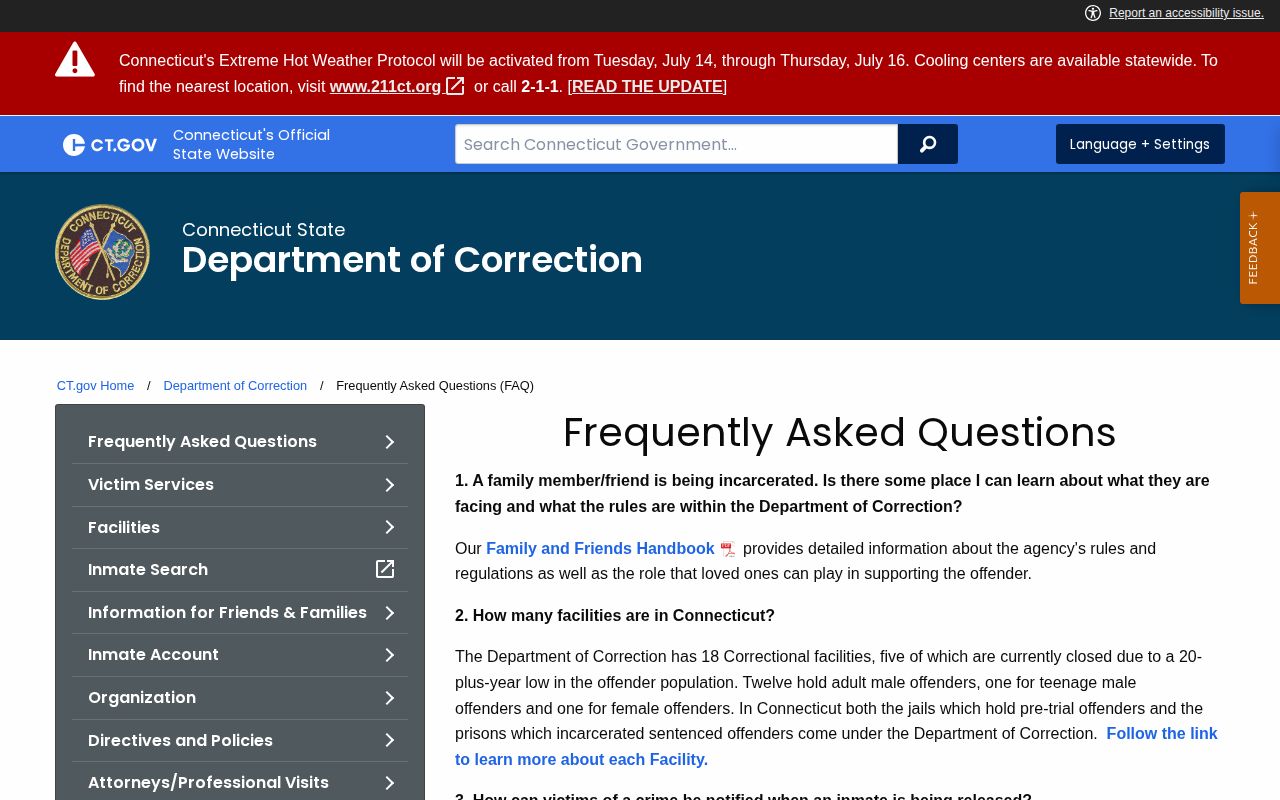
The field list supports the date names, while a case-specific DOC result or record is needed to apply them to one person.
Bristol Release Date Calculation
A Connecticut release calculation begins with the sentence imposed by the court and the offense date. DOC then accounts for presentence confinement credit where the law allows it. The next question is which legal route applies: a short definite sentence, a parole-eligible term, an 85% category, a parole-ineligible offense, a mandatory minimum, special parole, or another form of community release. The answer changes which date has practical value.
For many definite sentences longer than two years, CGS § 54-125a and BOPP policy provide a general parole-eligibility framework. Many eligible terms reach consideration after 50% of the total effective sentence less applicable jail or risk-reduction credits. Offenses involving the use, attempted use, or threatened use of force generally require 85% less jail credit. For qualifying offenses committed on or after July 1, 2013, BOPP says risk reduction earned credit does not reduce the 85% parole eligibility date.
Eligibility is only the date when the Board may consider parole. Suitability is the separate decision about whether release should be granted. Some offenses fall outside the general parole rule, while youth and young-adult provisions can have different thresholds. A public percentage alone cannot yield a reliable date without the sentence, credit record, offense category, and agency calculation.
Bristol Earned Credit Rules
CGS § 18-98e governs Risk Reduction Earned Credit for eligible people in DOC custody. The statute permits up to five days per month at the Commissioner's discretion for certain eligible sentences. Credit can depend on adherence to an accountability plan, approved programs and activities, good conduct, and obedience to rules. Good conduct alone does not create a right to the credit.
The statute excludes listed serious offenses and certain persistent dangerous felony or sexual-offender categories. Credit may be lost for misconduct, refusal to follow recommended programs, failure to obey rules, or other good cause. It cannot cut a mandatory minimum term. DOC must review and verify release eligibility before release, so a rough calendar calculation by a reader is not a substitute for the agency's record.
Older sentence categories may involve good conduct credit under CGS § 18-7a. That law contains different rules tied to older offense and sentence dates and allows loss for misconduct. Many modern calculations instead rely on risk reduction credit and parole law. Applying one simple "good time" formula to every Bristol sentence would be wrong.
The manifest image comes from the official earned-credit statute. Review the current text of § 18-98e when credit is central to the date.
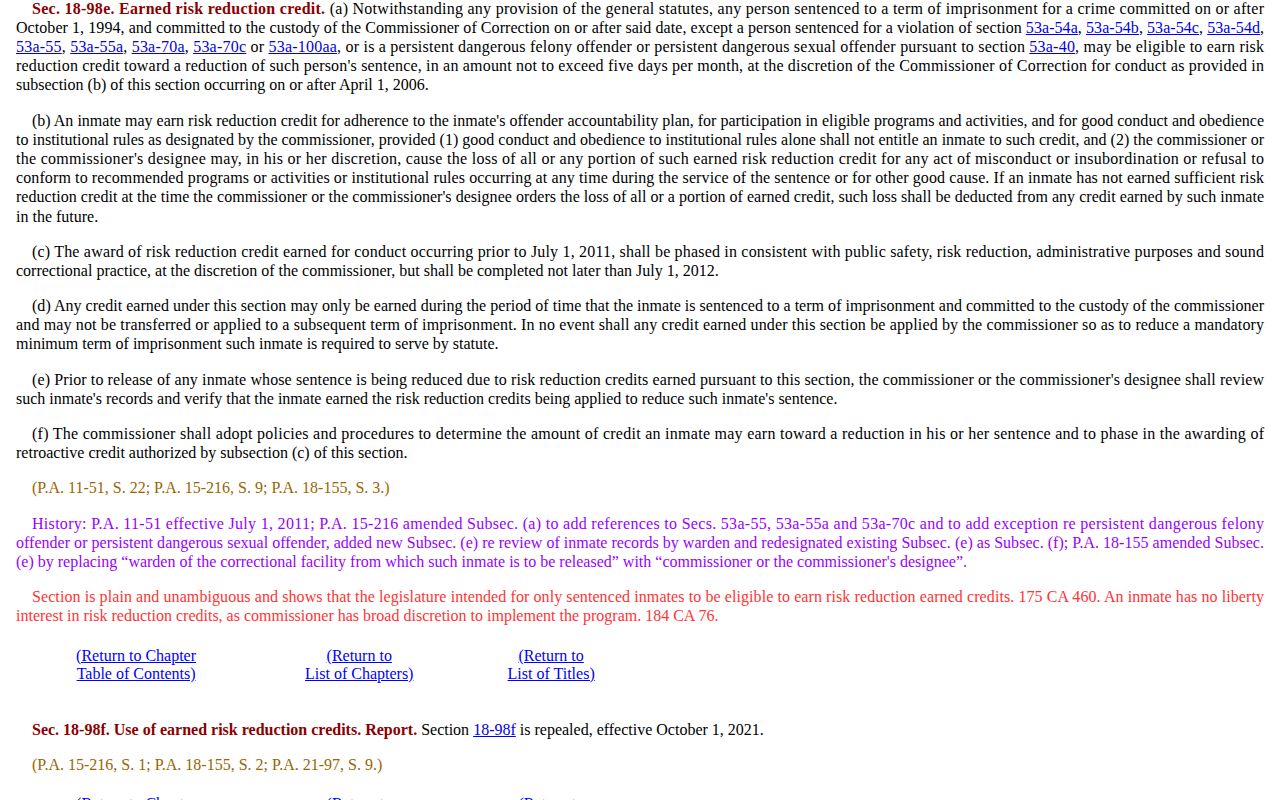
The statute shows why eligibility, retained credit, mandatory minimums, and DOC verification all matter before an estimated date becomes an actual release.
Note: Older good-conduct rules and modern risk-reduction credit are distinct systems; the offense and sentence dates control which rules may apply.
Changes to Bristol Release Dates
CT DOC describes public information as subject to quick change. Some factors move the calculation itself. Others leave the prison end date in place but change where the person goes or whether community release can occur. The court docket, DOC record, and BOPP record help separate those effects.
| Factor | Possible effect | Best confirmation |
|---|---|---|
| Earned credit | Eligible, earned, and retained credit may affect the estimate | DOC sentence calculation or FOI record |
| Disciplinary loss | Loss of credit can move an estimate later | DOC record and disciplinary history where releasable |
| Detainer or pending charge | The person may transfer to another authority instead of entering the community | DOC detainer field, court docket, or holding agency |
| Court order or sentence change | The legal basis or length of confinement may change | Judicial Branch docket and sentencing record |
| Parole decision | Grant, denial, continuance, or rescission can change the earliest supervised release | BOPP docket, minutes, FOI, and DOC |
| Sponsor or placement issue | A voted-to-parole date may pass before physical release | BOPP and Parole and Community Services |
A transfer is not a discharge. Likewise, a special parole date may mark the start of supervised release rather than the end of all state control. A separate federal or immigration hold must be checked in its own system.
Bristol Short-Sentence Release Paths
Shorter definite sentences have another Connecticut route. CGS § 18-100c provides that a person convicted of a crime, incarcerated on or after July 1, 1993, with a definite term of two years or less, may meet the statutory conditions for release to an approved community correction program after confinement for at least half the sentence less applicable credits. Possible placements named in the statute include a halfway house, group home, mental health facility, or another approved program.
This matters in Bristol because a local criminal case may result in a shorter sentence, but it does not turn Bristol Police into the release-date authority. The sentencing court establishes the term. CT DOC calculates custody and any program release. CSSD or parole staff may supervise a later community phase depending on the order and release type.
Confirm Bristol Actual Release Dates
A formal answer comes from the agency that owns the record. CT DOC Public Information handles offender-information questions at (860) 692-7780 from 8:00 a.m. to 4:30 p.m. Monday through Friday. The office is at 24 Wolcott Hill Road, Wethersfield, CT 06109. CT DOC's FOI Office uses the same address and lists (860) 692-6290, fax (860) 692-7873, and an online GovQA request route from its FOI page.
A request should include full name, date of birth, CT DOC number, facility, approximate admission and release dates, court docket, and the exact item sought. Ask for the release or discharge date, sentence calculation, movement history, detainer information, or special parole record as needed. Clear identifiers reduce delay and help distinguish people with similar names.
VINE is useful for a custody-change alert, but it is not a sentence-calculation record. The Bristol VINELink inmate search explains how to register, while the DOC or court remains the source for an exact official date. If parole controls the release, use BOPP minutes, FOI, and direct case contact as well.