
York Institution Release Routes
York Correctional Institution is Connecticut’s statewide correctional institution for women. CT DOC says it serves every superior court and manages both pretrial and sentenced female offenders at all security levels. A woman arrested in Bristol who enters state custody is therefore checked through York and the statewide DOC system, not through a Bristol jail roster.
A departure from York can mean release to the community after bond, court action, time served, parole, special parole, or sentence expiration. It can also mean movement within DOC, transfer to another agency, or a change tied to a detainer. The current DOC location and status must be read before a date is called a release. Court and parole records explain obligations that can continue outside the institution.
| York departure | Likely record path |
|---|---|
| Pretrial bond or court release | DOC status plus Judicial Branch docket |
| Sentence expiration | DOC release fields and formal record |
| Parole or special parole | DOC fields, BOPP records, Parole Services |
| DOC movement | Current location and movement history |
| Another agency hold | Detainer field and receiving-agency system |
Confirm a York Release
Start with the Connecticut DOC public inmate information search. Use the legal name or DOC number, then confirm date of birth, latest admission, current location, status, bond, and controlling offense. DOC reports that its public program receives a nightly feed from the Offender Based Information System, so a fresh move may lag behind the physical event.
- Find the person in the statewide DOC search and verify identity.
- Check whether York or another facility remains the current location.
- Read estimated, minimum, maximum, and special parole dates with the status.
- Check the court docket for bond, disposition, sentence, dismissal, or active case details.
- Use VINE for notice and request a DOC record when formal proof is needed.
A missing result does not prove release. The person may never have entered DOC, may be excluded from public display, may have an erased or restricted record, or may be in another agency’s custody. The Bristol release-record search explains how the police, court, DOC, and notification layers fit together.
York Release Records Contact
York staff can address institution-specific matters, while the CT DOC Public Information and FOI offices handle broader offender information and formal public-record access. A precise request should name the person, date of birth, DOC number if known, York as the facility, approximate custody dates, and the court docket when available.
York Correctional Institution
201 West Main Street
Niantic, CT 06357
Phone: (860) 451-3001
Fax: (860) 451-3200
Medical fax: (860) 451-3083
Security: Levels 2-5
CT DOC Records
24 Wolcott Hill Road
Wethersfield, CT 06109
Public Information: (860) 692-7780
Monday-Friday, 8:00 a.m. to 4:30 p.m.
FOI: (860) 692-6290
Fax: (860) 692-7873
Ask for the specific release or discharge date, movement history, sentence calculation, detainer, or correctional history needed. Public access can be limited by erasure, sealing, juvenile and youthful-offender rules, medical privacy, victim protections, or other law.
York Women’s Custody Role
York’s statewide role makes it different from Hartford Correctional Center. Hartford primarily holds pretrial adult men and directly serves Bristol court. York covers female custody from all Connecticut superior courts and houses both accused and sentenced women. It should never be described as a county jail or a Bristol-operated facility.
The official profile lists present staffing of 544 and security levels 2 through 5. The range reflects York’s responsibility for women with different legal status and security needs. These figures describe the institution, not an individual’s release likelihood or date.
York Release Search Fields
Connecticut’s public system can display the DOC number, name, date of birth, latest admission date, current location, status, bond, controlling offense, sentence date, maximum sentence, maximum release date, estimated release date, special parole date, and detainer information. The FAQ also identifies minimum release date, photograph, correctional history, and disciplinary history as information DOC may provide for a currently incarcerated person.
| Field | Release meaning |
|---|---|
| Current location | Shows whether York or another DOC site is listed |
| Status | Must be read before treating a date as final |
| Estimated release date | A working estimate, not guaranteed release |
| Maximum release date | A sentence-related outer date shown publicly |
| Special parole date | May mark the start of a supervision term |
| Detainer | May point to another agency’s custody claim |
A woman can be out of prison yet still under parole, special parole, or probation. Probation comes from the court and Judicial Branch CSSD. Parole and special parole involve BOPP and DOC Parole and Community Services. “Released” should always be paired with the system she left.
York Court and VINE Checks
The Judicial Branch Criminal/Motor Vehicle Case Look-up can preserve the public case trail after custody ends. Pending and conviction searches, docket-number routes, and daily dockets can show whether the case remains active, ended in a sentence, was dismissed, or followed another public disposition. This is especially useful after a short pretrial stay.
Connecticut VINE supplies custody-status and case notifications. It is not a historic roster or a certified release document. State guidance also warns that court-case and inmate-custody notifications may require separate registration under the inmate ID. When a VINE alert arrives, compare it with DOC status and the court record.
York’s Correctional History
The official York facility profile places the present institution in a much older women’s correctional history. Niantic Correctional Institution was founded in 1918. York opened in October 1994, York and Niantic consolidated in 1996, and the Niantic Annex closed in January 2016 after a continued decline in the prison population.
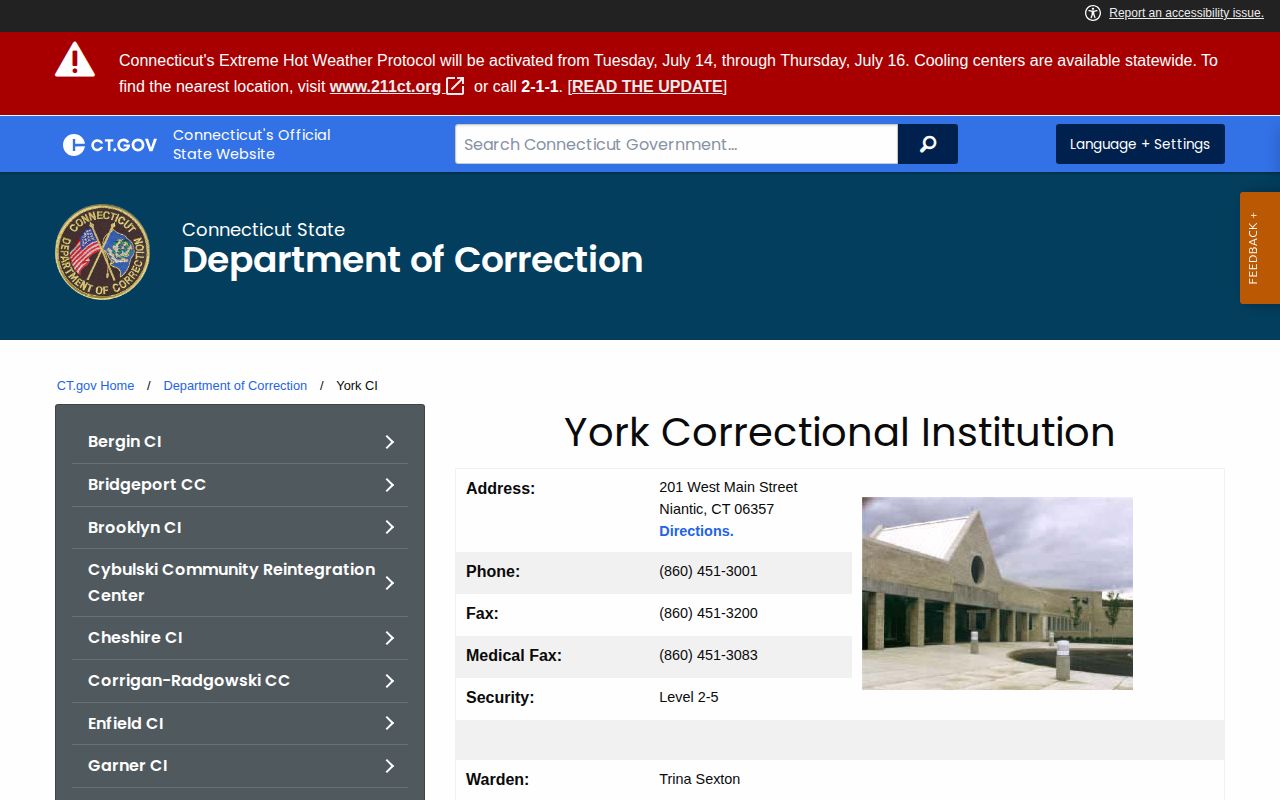
The profile confirms York’s subject and statewide function, which is why a Bristol woman’s correctional record belongs in the DOC path rather than a local police roster.
This history is York-specific and should not be used to infer current custody. The live state record and the originating court remain the person-level sources.
After a York Release
Parole and special parole require a supervision check when they apply. BOPP hearing dockets, public meeting minutes, and DOC Parole and Community Services can explain the transition. BOPP notes that a voted-to-parole date is an “on or after” date, meaning it is the first possible day rather than a promise of same-day physical release.
CT DOC Offender Re-Entry Services also has a concrete post-discharge rule. Identification left behind stays at the discharging institution for 30 days, then goes to Central Office and may remain there for up to two years. York is therefore the first contact for recently unclaimed identification; Central Office becomes the later route.
- Pretrial
- Held while the criminal charge remains pending.
- Discharge
- The custody or sentence term ends, although other supervision may remain.
- Parole
- Part of a prison sentence is served in the community under DOC supervision.
- Probation
- Court-ordered community supervision through Judicial Branch CSSD.
Note: VINE provides notice of a status change, while a DOC or court record supplies the stronger explanation of what changed.
York Formal Release Requests
A formal DOC request becomes important when York no longer appears, the public result lacks history, or a precise discharge date is required. Identify the woman by full legal name, date of birth, DOC number, York custody dates, and court docket if known. Then name the record: discharge date, movement history, sentence calculation, detainer, photograph, or correctional history.
Movement history distinguishes a true release from an institutional move. A court record explains whether bond, sentence completion, dismissal, or another judicial action affected custody. BOPP records clarify parole action, while Parole and Community Services handles the supervision side after release. These records should agree on identity even when their dates describe different steps.
Public access remains subject to Connecticut erasure and other limits. Some dismissed, not-guilty, or matured nolle cases may be erased under statute. Juvenile, youthful-offender, sealed, medical, and protected victim information may also be unavailable. The absence of a public result should be reported as an unresolved record condition, not converted into an unsupported claim about the woman’s history.
York’s statewide role also means the originating court may be far from Niantic. A Bristol case belongs with GA17 or the court shown on the docket, while York maintains the correctional side. Matching the court number to the DOC identity helps separate a case disposition from the later physical release date. It also reduces confusion between a court order and the later completion of the institution’s release process.