
Bristol 72 Hour Release Window
Bristol Police does not publish a rolling release list for three days. There is also no Hartford County sheriff roster because Connecticut correctional custody is state-run. The Bristol Police Arrest Blotter offers dated local arrest entries. It can anchor a review across several days, but it cannot answer whether any named person was released.
The three-day window is still practical. It gives court, DOC, and notification records more time to reflect an event than a same-day check. It also lets a reader compare several blotter dates rather than treating one calendar date as the whole record. A person arrested late on one day may appear in court or move into DOC custody on the next.
Review Bristol Three-Day Releases
A careful 72-hour review starts with the event date and then follows the person through each system. Keep the arrest date separate from the court date. Also note whether the suspected custody was local police processing, CT DOC, federal custody, or immigration custody.
- Open the Bristol blotter and inspect each dated entry within the three-day span. Collect the full name, arrest date, charges, court date, and listed bond.
- Search the CT DOC public inmate system. Use the inmate number if known, or narrow a name result with date of birth.
- Check the Judicial Branch criminal lookup under both pending and conviction paths. Use a docket number when available.
- Check Connecticut VINE for a participating custody status and register for later changes if the status is still open.
- When the sources disagree, request the police, court, or DOC record that documents the precise release, discharge, or transfer event.
Do not combine people with similar names. Match date of birth, inmate number, court, docket, custody agency, and case details before reading a status as the same person. The Bristol County released inmates search gives the broader path for one named individual whose custody history extends beyond this three-day review.
Note: A three-day review improves context, but it does not convert the arrest blotter or current DOC search into a release archive.
Bristol 72 Hour Source Fields
The best substitute for a 72-hour feed is a comparison of official sources. Each row below has a different role. Use the arrest record to locate the event, the state search to inspect custody, the docket to follow the case, and a records request to obtain formal documentation.
| Source | Fields or value | Limit |
|---|---|---|
| Bristol arrest blotter | Dated entry, arrest date, court date, charges, and bond | Arrest context only; no release status |
| CT DOC inmate search | Status, current location, bond, offense, sentence and release fields, detainer | Daily data can lag and public display is not a full archive |
| GA17 court lookup | Pending or conviction path, docket, public case status, disposition and sentence context | A case can remain active after custody ends |
| Connecticut VINE | Custody-status signal and notification choices | Alert layer, not a historic release list |
| Bristol Records | Police report and local arrest documentation | Arrest reports wait until all charges are adjudicated |
| CT DOC FOI | Formal DOC custody, release, discharge, or movement record request | Requires a focused request and agency processing |
A displayed bond amount remains a clue, not proof that the person met the bond. Likewise, leaving Hartford Correctional Center can mean transfer after sentencing rather than release to the public. The field must be read with the custody location, status, and court record.
Bristol Weekend Release Timing
A 72-hour span is most useful when it crosses a weekend, holiday, or late-day event. Bristol blotter entries are dated police records. Court docket entries follow court processes. CT DOC says its public information is updated daily, and its OBIS public-search feed runs nightly. Those schedules do not promise that each system changes at the same moment.
Suppose an arrest occurs late Friday. A blotter entry may establish the arrest and next court date. A later DOC result can show state intake or a current facility. Court action may then set bond, release terms, a continuance, or another status. A missing result on Saturday does not settle which event happened. Review the next available postings and use VINE or an agency record to confirm the custody change.
Holidays create the same issue. The wider span catches more dated entries, but public office hours and posting cycles can delay confirmation. Avoid assigning a release time that no official source reports. If exact time matters for a legal or personal record, ask for the specific booking, movement, or release document.
Build the window from actual calendar dates, not from a loose phrase such as "this weekend." Save the dated blotter links and note when each DOC or court check was made. If a status changes between checks, that sequence can identify the point that needs formal confirmation. It still cannot establish the reason for release without the underlying court or correctional record. For someone serving a state sentence, maximum, estimated, or special parole dates are planning fields and should not be recast as proof of an event during the chosen 72 hours.
Bristol Blotter Is Not Release
The Bristol arrest blotter’s dated format is a distinctive local clue. Research found late June and July entries, including one entry stating there were no arrests. That shows the page can help reconstruct recent police activity across several dates. It does not show everyone who left police, court, or DOC custody during those dates.
For each matching entry, move beyond the bond figure. Search the court date and defendant in the GA17 path. Then compare CT DOC location and status. If the person never reached DOC, the court docket and Bristol Records Division may be the only local public routes. Reports are generally available in three working days, but reports containing arrest information remain unavailable until all charges have been adjudicated.
- Arrest entry
- A record of police action, not proof of current custody or release.
- Current status
- The agency’s presently displayed custody state, which can change after the latest update.
- Transfer
- Movement to another correctional or government authority without release to the community.
- Release record
- An agency or court record that documents how and when custody ended.
Note: Bristol’s dated entries are useful breadcrumbs, while the formal release fact comes from DOC, court, VINE confirmation, or records.
Bristol Release Status Checks
Connecticut DOC is the main correctional lookup because state government runs both pretrial correctional centers and prisons. A person shown at a current location may still be in custody. A person no longer shown could be released, but absence can also result from no DOC intake, spelling mismatch, a restricted record, a youthful-offender rule, federal custody, or an ICE-related exclusion.
| Observed result | Follow-up |
|---|---|
| Current DOC facility and status appear | Check the record date and confirm any recent transfer or scheduled release with DOC. |
| No DOC result, active Bristol case | Review the GA17 pending docket and local police record path. |
| DOC location changed | Do not assume release; compare the new location, sentence, and movement record. |
| VINE sends a custody change | Confirm the release date or transfer through DOC or court if a formal record is required. |
Federal release information belongs in the Bureau of Prisons locator. Immigration custody belongs in ICE ODLS. Neither source is a Bristol 72-hour list, and Connecticut VINE does not replace them.
Keep custody types separate when reviewing several people. A Bristol arrest followed by GA17 action is a local police and court trail. A discharge from a Connecticut prison is a DOC trail. A federal result belongs to BOP. Combining those records into one informal list can hide a transfer, mistake a court release for a prison discharge, or attach the wrong date to the wrong authority.
Bristol Release Alerts and Proof
The official Connecticut VINE service can send custody-change notices when the person and participating record are found.
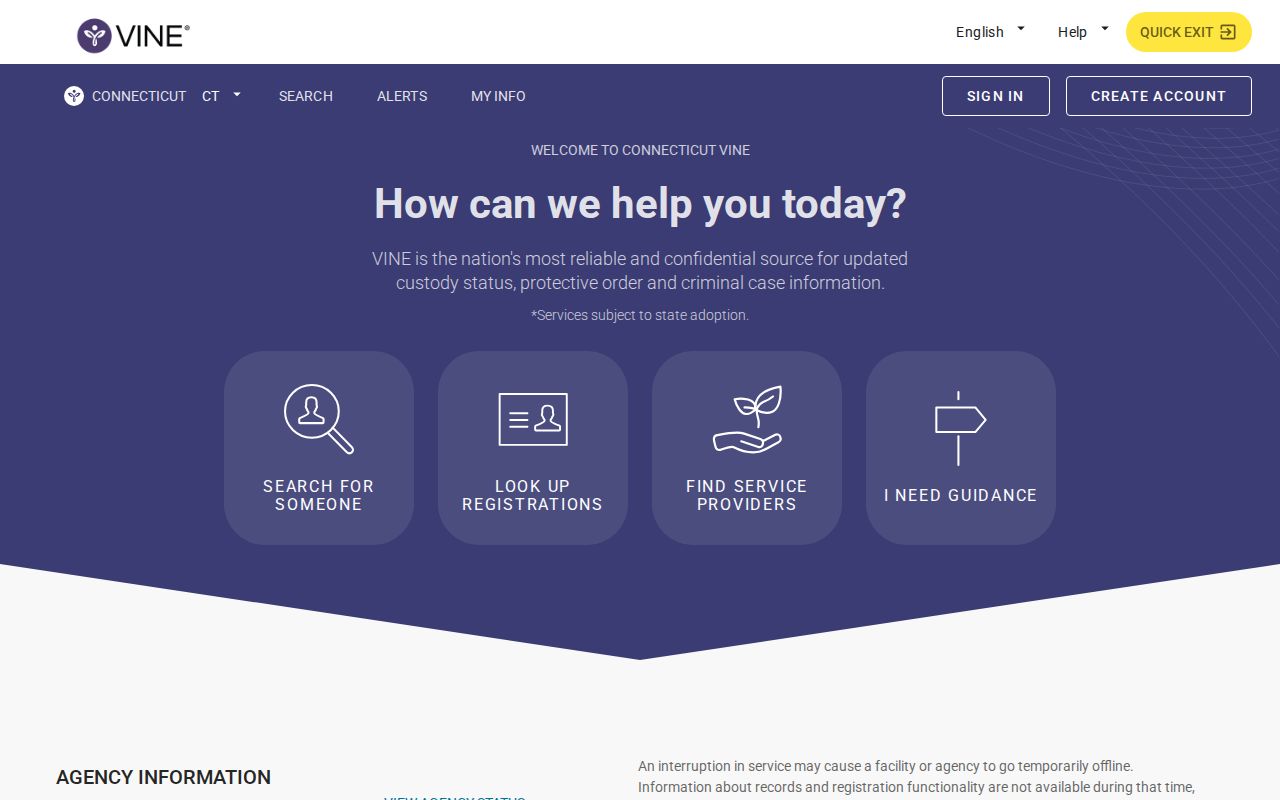
This capture identifies the state alert path. VINE supports a specific-person check, not a browsable list of all Bristol releases during the last three days.
A formal fallback should name the record sought. Bristol Records handles police documents. The CT DOC Freedom of Information Office handles DOC record requests. Include the full name, date of birth if known, event dates, inmate number, docket number, and whether the request seeks release date, discharge, movement history, or detainer information.
For a same-day event where speed matters more than a wider date sweep, the Jail Releases: 24 Hours page narrows the process to the latest arrest, custody, court, and VINE signals.